
Stevens Point Directory Collections
The core Stevens Point city directory collection is a set of digitized volumes associated with UWSP Archives and local library research. It is not one unbroken annual run. Each date must be checked as its own publication, with its own contents and rules. The 1896 Portage County title reaches beyond the city. The 1965 number-change guide draws names from a 1964 Polk directory, but it is a crosswalk rather than a complete scan of that volume.
| Collection | Years located | Where held | Access |
|---|---|---|---|
| Stevens Point city directories | 1889-90, 1893, 1901-02, 1920-21 | UWSP digital collection | Direct PDFs; inspect page images |
| Portage County directory | 1896 | UWSP and PCPL-linked collection | PDF and reference help |
| Renumbering guide | 1964 names; effective August 1, 1965 | Portage County Historical Society | Public PDF |
| Tattler yearbooks | PCPL: 1909-1977; collection: 1916-1976 | PCPL and Recollection Wisconsin | Verify each volume |
| Sanborn maps | 1884, 1891, 1898, 1904, 1912 | LOC and WHS | Digital sheets |
Those gaps matter. “1889 through 1921” would falsely suggest continuous coverage. Log title, year, PDF page, printed page, and section for every find. If a year is absent online, ask the library, UWSP Archives, or historical society about a physical volume or related source.
Access also changes with format. A PDF can be read at home, while a fragile book, database, microfilm reel, or archive box may require a visit. Ask whether copies are allowed and cite the host rather than reproducing a publication. Keep the access route with the volume so another person can repeat the Stevens Point directory search.
Inside Stevens Point Directory Volumes
The 1893 directory describes residents plus city and county officials, police and fire departments, churches, societies, and postal information. The 1896 Portage County volume includes adult Stevens Point residents, a street directory, county and town listings, businesses, and local history. Its stated rules distinguish names over age 16 and some taxpayer-only town entries. This helps explain uneven representation.
The 1901-02 contents add cemeteries, courts, newspapers, schools, and societies. The 1920-21 volume includes citizens, firms, rural routes, a street guide, banks, railroads, officers, churches, and classified businesses. Decide whether a hit describes a home, office, shop, or civic role. Never turn a business listing into a residence claim.
Use the scan instead of OCR, the automated text made from an image. Old type, tight columns, initials, and damaged paper can produce false spellings. Search several forms of a surname, then read nearby lines.
Read Stevens Point Directory Entries
A sound transcript preserves the publisher's words without filling gaps from memory. Capture the full name, household note, occupation or business, address, and symbols. Note whether the hit came from alphabetical names or a street section. No fully cited individual entry was extracted in the research, so one universal set of marks cannot be assumed.
| Source | Year, title, printed page, image, and section |
|---|---|
| Name | Exact spelling and initials |
| Role | Occupation, business, office, or household wording |
| Address | Number, street, direction, and separate business site |
| Marks | Spouse, widow, boarder, owner, or residence only when defined |
The key may change between volumes. Save it with the entry when rules permit. This prevents a short form in one book from receiving a meaning found in another.
- Criss-cross directory
- A book arranged by street or address.
- Householder index
- An address-based list made under a publisher's inclusion rules.
- Abbreviation key
- The volume's own legend for marks and short forms.
Stevens Point Library Research Desk
The Portage County Public Library genealogy collection is the practical local hub when a scan is missing or unclear. Its second-floor desk holds newspapers, yearbooks, family histories, and city directories. Reference help is available at 715-346-1548 and online. Ask for a title and year, not everything on a surname.
The library's official genealogy page shows the range of local history tools available.
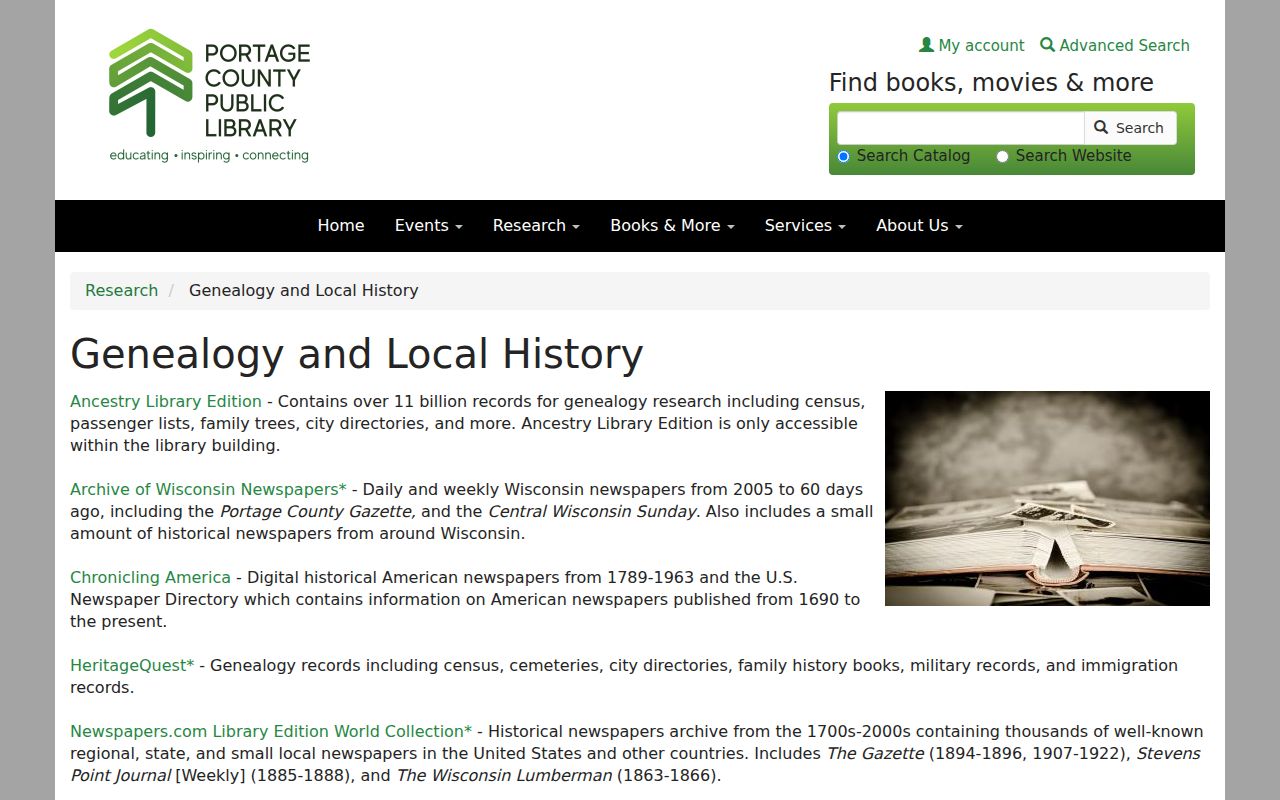
The captured page is a starting point; confirm whether a database requires a library visit before planning the search.
Some databases require an in-library visit or Wisconsin library access. Ancestry Library Edition is available in the building. HeritageQuest and BadgerLink follow their own access rules. Locally noted newspaper runs include Gazette 1894-96 and 1907-22, Stevens Point Journal Weekly 1885-88, and Wisconsin Lumberman 1863-66. None is a complete newspaper archive.
After an index hit, retrieve the newspaper or microfilm page. Record publication, date, page, column, and whether Stevens Point was a home, former home, funeral site, business place, or only a mention.
Stevens Point Archives Access
UWSP Archives combines university holdings, Portage County Historical Society material, and the Wisconsin Historical Society Area Research Center. Visits are by appointment. Published hours are weekdays 10 a.m. to noon and 1 to 4:30 p.m.; call 715-346-2540. Send names, dates, titles, and addresses before visiting.
The Portage County Historical Society research page links CatalogIt, UWSP collections, and the renumbering guide. Requests go to collections@pchswi.org. Stated charges are $25 per hour for individual research and $100 for business research, with a member waiver. The fee buys staff time, not a promised result.
Finding aids explain who made records, how they were arranged, and why years are missing. Bring a research log so staff can focus on open questions.
Stevens Point's 1965 Number Change
August 1, 1965 is a key break. The Stevens Point renumbering guide pairs a number used in 1964 with an occupant name from the Polk directory and a new number. It lets research cross the change without guessing. Someone can appear to move when only the number changed.
Treat the occupant as a lead. Confirm both numbers with a directory page, tax or deed record, map, permit, or newspaper. Annexation, replatting, unit changes, and renamed streets may create other breaks. Modern parcel syntax also differs: state parcel numbers use a 281 prefix, while the city search says to omit 281 and punctuation.
Map Stevens Point Directory Addresses
Sanborn maps add building context. Official metadata identifies Stevens Point sheets for 1884, 1891, 1898, 1904, and 1912. They show streets, footprints, use, materials, outbuildings, and fire-risk details. They do not usually name each resident, and a matching footprint does not prove the same building survived.
The WHS 1891 Stevens Point record shows a dated map in its collection context.
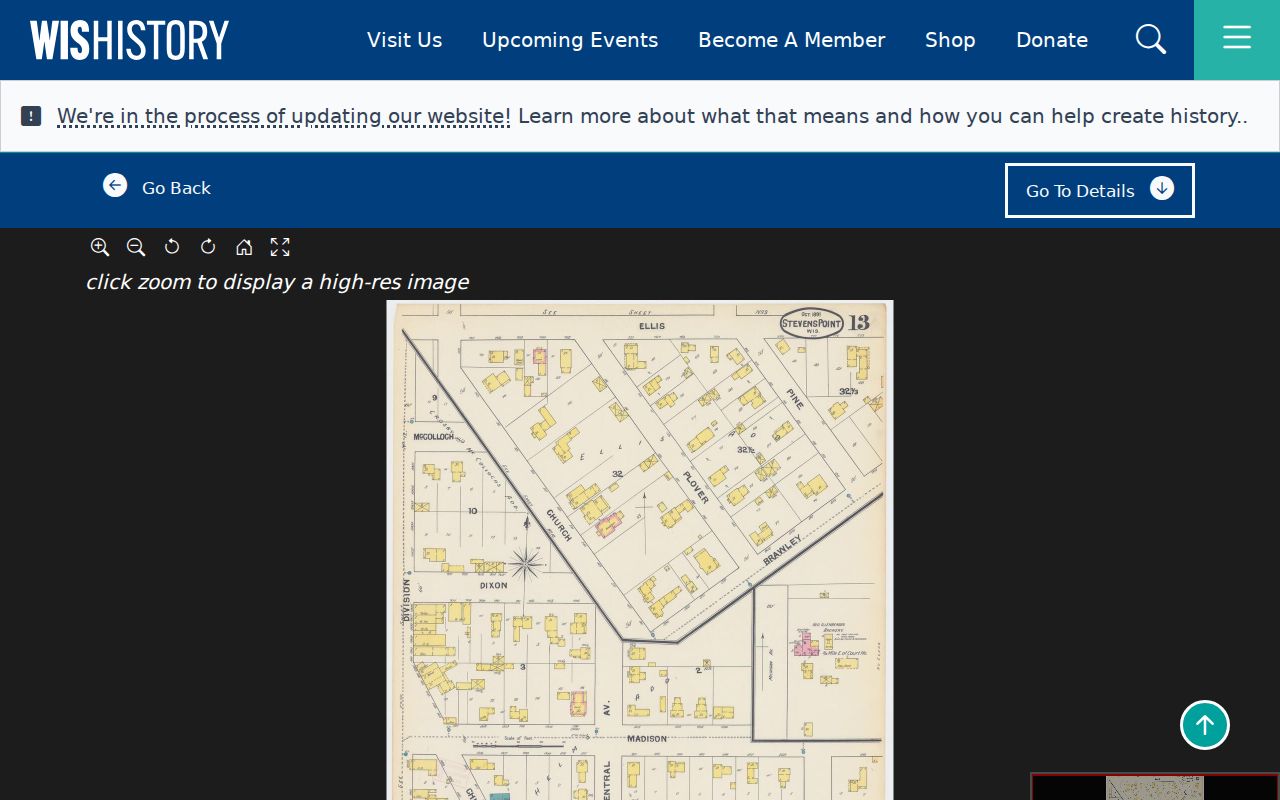
The screenshot ties the map to its date and collection. Compare the right sheet with the directory year and legal description before connecting it to a modern parcel.
Stevens Point Genealogy Companions
The Central Wisconsin Genealogy Index covers Portage obituaries, naturalizations, and selected census years, including 1850-1880 and 1900. It points to an original source; it is not the obituary, schedule, or court file. SPAGS adds cemetery searches, Wisconsin Pinery indexing for 1853-1890, Plover Times indexing for 1866-1881, and a route to a Stevens Point Journal index for 1992 through November 2005.
The index screen can follow a name that disappears from a city directory.
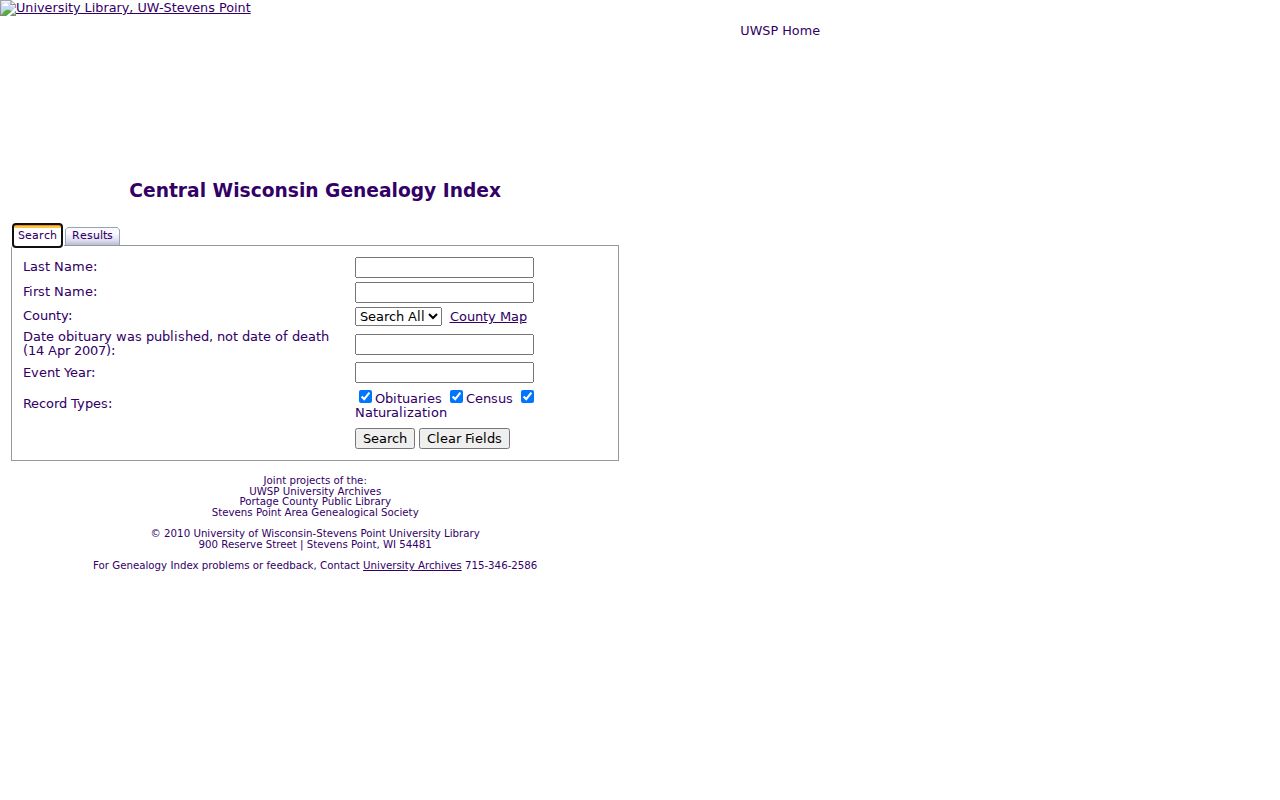
A disappearance may reflect death, a move, spelling, non-inclusion, or a missing volume. Retrieve the original before choosing among them. Yearbook spans also conflict: PCPL says 1909-1977, while collection metadata says 1916-1976. Cite only the volume inspected.
Trace Stevens Point Family History
A city directory sequence can fill years between census snapshots. Start with the clearest dated record, preserve its spelling and address, and move one volume at a time. Keep the result as sourced observations until independent evidence supports a conclusion.
- Find a clear alphabetical entry and record title, section, and page.
- Check the street section in the same book, if present.
- Move to prior and later available volumes, logging missing years.
- Use the 1965 guide when the trail crosses the number change.
- Pair directory years with census, newspaper, parcel, or deed evidence.
The comparison source should match the claim. A census fixes a household at an enumeration date, but the latest public federal schedule in the researched set is 1950. A cemetery index identifies burial and may not state a home. A naturalization index supplies a petition or declaration lead, not the whole file. An obituary may describe a last home, former home, funeral site, relatives, or burial. Transcribe the exact relationship rather than flattening all of them into residence.
Property evidence requires the same care. A parcel record can name an owner or tax-mail recipient who did not occupy the building. A deed can mark a transfer without saying who lived at the site that day. A Sanborn sheet can show a footprint and use but usually not a household. The strongest Stevens Point city directory conclusion pairs these different roles and dates while keeping their limits visible.
For a modern check, use the Stevens Point resident lookup. Keep owner, occupant, student, officer, and person mentioned as separate roles.
Close the log with unreadable scans, conflicting spellings, missing volumes, and all inferences. This keeps the trail repeatable.